How much space does a person actually need to live? Naturally, there are as many opinions on this question as there are people – everyone has their own unique needs and views. But what is the reality?
To answer this question, numerous articles and datasets had to be analyzed, as there is no universally adopted global standard for required living space per person.
In emergency situations involving refugee resettlement, the United Nations High Commissioner for Refugees (UNHCR) recommends a basic minimum of 4.5–5.5 sqm of living space per person. In the UK, the minimum living space per person is set at 37 sqm, while in Japan, it is 25 sqm. The European Union, on the other hand, tracks these statistics using the number of rooms per person rather than square meters.
According to the World Health Organization (WHO), housing space should be sufficient for people of different ages to live comfortably and should provide enough space to satisfy their personal needs.
In reality, however, countries vary significantly in their economic conditions, territory, lifestyle, climate conditions, and geopolitical stability.
Consequently, average living space per capita also varies. Overall, broad data shows that in highly developed countries such as the US, Canada, and Australia, average living space per capita ranges from 50 to 90 sqm. In densely populated regions like Western Europe, South Korea, and Japan, it falls between 30 and 45 sqm, whereas in low-income urban centers in India and parts of Africa, it ranges from 10 to 15 sqm.
Country-by-Country Data
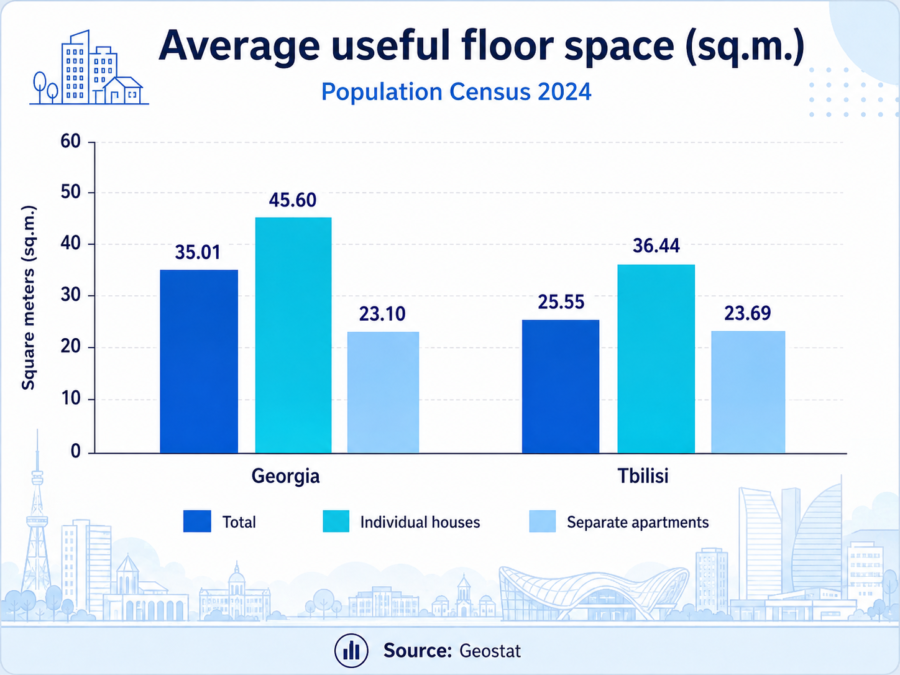
Let’s start with Georgia: according to Geostat and the 2024 population census data, the average total living space per person in Georgia is 35 sqm. For individual houses, this figure stands at 45.6 sqm, while for apartments, it is 23.1 sqm. In Tbilisi, the average total space per person is 25.55 sqm (Source: Geostat).
In Hong Kong, official statistics show that average public rental housing space is 14.1 sqm per person, up from 13.1 sqm in 2015. At the same time, the average area of newly built homes has declined over recent decades: it was 50.4 sqm in 1995 compared to 37.2 sqm in 2024. Roughly 45% of apartments built in recent years are smaller than 40 sqm. Despite this, homes in prime locations can reach prices of 10 million Hong Kong dollars ($1.27 million) or more.
Data published in 2026 by China’s National Bureau of Statistics reveals that in 2025, residential space per capita for the urban population exceeded 40 sqm. However, an important methodological nuance applies here: statistical data in China often measures total building gross area rather than usable indoor living area.
In Vietnam, average living space per person is 26.6 sqm; in Brazil and Argentina, it is around 30–35 sqm; in Indonesia, 20 sqm; in Nigeria, 6 sqm; and in Kenya, 8 sqm.
In Australia, average household size has declined significantly: from 4.5 people per household in 1911 down to 2.5 people in 2024. Conversely, the average floor area of single-family homes has expanded: from 100 sqm in the 1950s to 236 sqm in 2020. Today, living space per capita in Australia averages 84 sqm, making it one of the highest in the world.
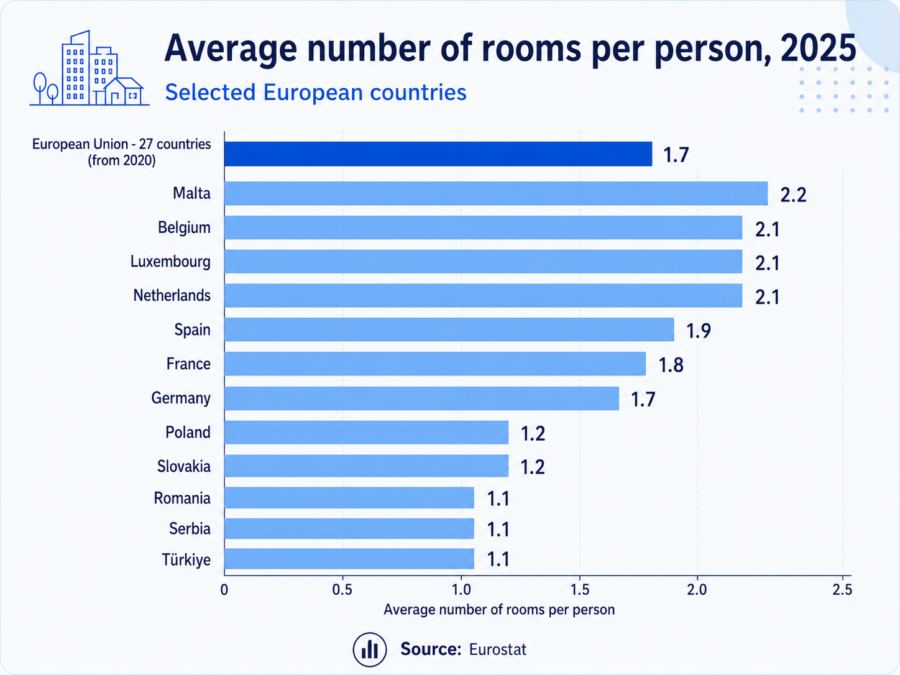
As mentioned, the European Union measures housing space by room count. According to Eurostat, the latest 2025 data shows an average of 1.7 rooms per person. In 2025, Malta recorded the highest metric at 2.2 rooms per person, followed by Belgium, Luxembourg, and the Netherlands at 2.1 rooms per person. Spain stands at 1.9 rooms per person, France at 1.8, and Germany at 1.7. The lowest metrics are recorded primarily in Central and Southeastern Europe: Romania, Serbia, and Turkey average 1.1 rooms per person, while Poland and Slovakia average around 1.2 rooms.
Is Home Size Directly Proportional to a Happy Life?
Studies show that home size does not automatically dictate human life satisfaction; functionality and many other factors play a crucial role.
According to data from the US Census Bureau, average living space per person in newly built homes exceeds 87 sqm today, compared to roughly 51 sqm in 1973. Additionally, while the typical single-family house area was about 158 sqm in the 1970s, it now stands at approximately 223 sqm.
The Washington Post notes that more space does not automatically guarantee greater happiness, and fewer people now live in these larger homes. According to the US Census Bureau, the average household size living in such homes has dropped to a historical low of 2.5 people.
“The American Dream is virtually synonymous with a larger, suburban house. But as the size of the average American home has nearly doubled, the people living in them aren’t any happier,” writes Michael J. Coren in his Washington Post article titled “Why smaller houses can lead to happier lives”.
According to studies discussed in the article, moving to a larger home initially boosts satisfaction, but over time, happiness levels often return to baseline. Research suggests that beyond the space required for safety and comfort, additional square footage yields diminishing returns on overall happiness.
One key reason lies in the expenses tied to larger homes: higher mortgage debt, property taxes, maintenance costs, and often longer commutes due to living farther from work. Consequently, people may end up with less time for family, friends, and social connections.
Studies cited in the article indicate that up to 60% of a home’s area often goes practically unused most of the time. Even in large homes, family members tend to gather primarily in a few shared spaces – the kitchen, dining room, and living room. Therefore, a well-planned, smaller living space can often prove more valuable than a sprawling yet less functional home.
The article also highlights another interesting phenomenon: the “McMansion effect.” According to research by Clément Bellet from Erasmus University Rotterdam, the satisfaction gained from moving into a larger home drops significantly if the neighbors’ homes are even bigger. People’s wellbeing is heavily influenced by whether they compare their homes to those around them.

Similarly, a 2023 study conducted in Vancouver showed that dwelling type had no major impact on overall life satisfaction, with the exception of basement units under 28 sqm, where reported wellbeing was lower.
The Washington Post also emphasizes the surrounding environment. Research suggests that factor choices such as affordability, proximity to friends and family, access to public transport, parks, public spaces, and walkable neighborhoods often matter much more to human satisfaction than home size alone. In fact, home design ranked only eighth on the list of priorities. According to the article, Europeans live in smaller homes on average, yet prioritize walkable neighborhoods, vibrant public spaces, and social infrastructure.
Finally, another compelling fact: living space also has a significant environmental footprint. According to an EU-commissioned study, approximately 40% of CO₂ emissions are linked to buildings.
This includes not only operational energy used for heating and cooling an existing building, but its entire life cycle: construction, material production, operation, renovation, and eventual demolition. Researchers examined around 15,000 building models to evaluate emission impacts under various scenarios: energy-efficient upgrades, renewable energy integration, and demand reduction. Reducing living space emerged as one of the single most powerful factors. According to the authors’ estimates, reducing average living space by just 2 sqm per person had a greater impact than any other measure studied.
As these examples illustrate, there is no straightforward answer to the question: “How large of a home does a person need for a comfortable life?” However, modern trends increasingly show that what matters most is not pure square footage, but how well the space fits individual needs.
In recent years, demand for compact and studio-type apartments has grown steadily, particularly in urban centers. Such homes offer low utility and maintenance costs for independent living and present easy-to-manage rental and investment opportunities. Kedaro Group continuously monitors real estate market trends, consumer demand, and global developments to help clients select properties tailored to their unique needs and goals.
Cover image generated by Artificial Intelligence.
Author: Lika Kasradze
If you are considering investing in real estate in Georgia, Kedaro Group is ready to provide you with professional guidance.
Contact us:
Email: kedarogroup@gmail.com
Phone: +995 593 618 181
Address: 18/22 G. Atoneli Street, 0105 Tbilisi, Georgia