Statistics show that, in most countries, the share of the population living under its own roof significantly exceeds 50%.
“An Englishman’s home is his castle” – this well-known British phrase dates back to the 17th century. In 1604, during one court hearing, the prominent English lawyer, judge and politician Sir Edward Coke stated: “That the house of every one is to him as his Castle and Fortress as well for defence against injury and violence, as for his repose.”
Georgians also like to say: “I prefer my own hut to someone else’s palace.” Through this well-known saying, people express the idea that their own home is a source of strength, a place where they feel calm and protected. Indeed, owning real estate is a guarantee that, even if a person is left without any income, they will “at least still have a roof over their head.”
However, we have often heard the opposite view: that in developed countries, no one burdens themselves with buying property or spends their one short life carrying decades of debt.
We have heard that in Western countries in Europe, the United States and Canada people are so economically protected that they have no problem paying rent and do not take on an enormous financial burden to purchase their own home. Supporters of this model sometimes portray those who struggle to buy their own housing as financially uninformed.
Arguments used to support the advantages of renting include flexibility: being able to change neighbourhoods or cities easily, even depending on the location of one’s workplace; freedom from mortgage debt, repairs and unexpected expenses; and the possibility of using savings for other purposes.
Despite these arguments, renting is still associated with poverty for many people in Georgia, and this model of living has not taken root here. We often hear phrases such as “rent belongs to the devil” or “money paid in rent is money thrown away.” In Georgia, most people still devote a large part of their income to acquiring their own “castle”, in other words, a roof over their head even if this means taking out a 20-year bank loan.
Let us now look at the statistics and examine the reality in Georgia and around the world. By way of clarification, statistics do not directly count the number of legal property owners. Instead, they measure ownership at household or family level, where residential property may be registered in one person’s name but shared by other family members.
Georgia
According to Geostat, based on the 2024 population census, approximately 89.8% of the population lives in a dwelling owned by one or more members of the household, while around 6.5% lives in rented housing. The remaining population lives in mortgaged, rent-free or otherwise classified housing.
The difference between urban and rural settlements is noticeable: in cities, approximately 85.6% own their housing, while 9.9% rent; in rural areas, 96.8% own their homes and 0.9% rent.
Europe
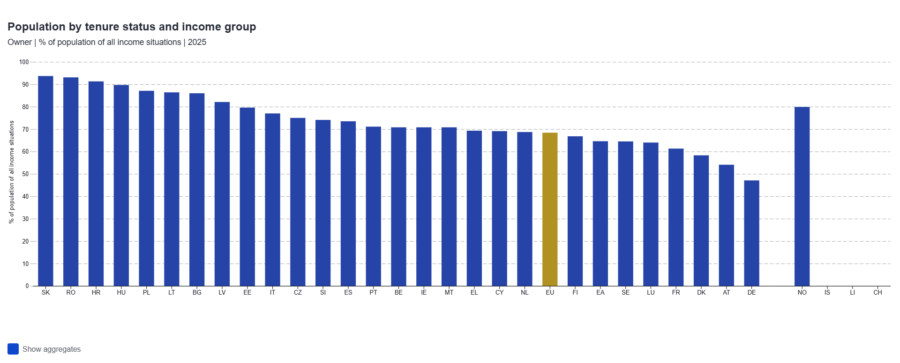
According to the latest 2025 report published by Eurostat, the statistical office of the European Union, 68% of the EU population lives in owner-occupied housing, while the remaining 32% lives in rented accommodation.
Looking at the data available since 2010, this figure has fluctuated between approximately 68% and 71%. Up to 25% of the EU population lives in owner-occupied housing purchased with a loan or mortgage, while 43% lives in housing owned without any loan. In the euro area, the share of people who own their home is 64%.
The highest shares of people living in their own homes in Europe are found in Romania and Slovakia close to 94%. Hungary and Croatia are in the 90% range. The figures are 87% in Poland, 86% in Lithuania, 82% in Latvia, 77% in Italy, 73% in Spain, 71% in Portugal, 70% in Belgium, Ireland and Malta, 69% in Greece, 68% in the Netherlands and 61% in France. The figures are 64% in Sweden, 66% and in Finland. A relatively high share of tenants is found in Austria – 46% and Denmark – 42%.
Overall, in almost every EU member state, the share of homeowners exceeds the share of tenants. Germany is the only exception, with 53% of the population living in rented housing.
It should also be noted that access to housing is one of the major challenges in the European Union, and leaders are discussing the issue at different levels. According to “The EU’s Housing Crisis”, published on the official website of the Council of the European Union, apartment prices in the EU have increased by an average of up to 60% since 2015, while in some countries the increase has exceeded 200%.
At the same time, rents and utility costs are rising, while incomes are failing to keep pace. Housing costs now account for almost one-fifth of the average household’s income, and approximately one in ten Europeans is unable to pay rent or a mortgage on time. In major cities, one in ten residents spends more than 40% of their income on housing. The crisis is mainly driven by rising property prices and rents, insufficient construction, urbanisation and demographic change.
United States
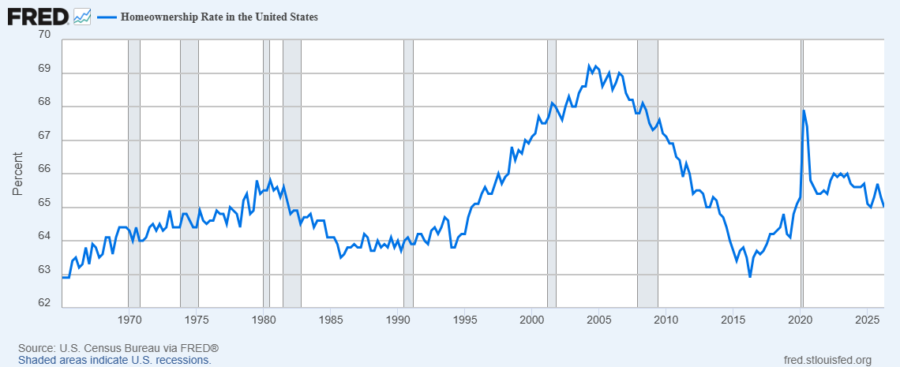
According to the latest available 2026 Q2 from the U.S. Census Bureau, the share of owner-occupied housing units is 65%. The highest rate was recorded in 2004 – 69.2%, while the lowest was in 2016, at close to 63%.
In the United States, the homeownership rate increases with age. It stands at 35% among those under the age of 35, 60% among people aged 35–44, 69% among those aged 45–54, 75% among those aged 55–64 and 78% among people over the age of 65.
It should also be noted that owning a home does not always mean freedom from financial obligations. In the United States, for example, many people choose not to keep an inherited home because property taxes, insurance, repairs and maintenance can be so expensive that owners prefer to sell the property.
“One of the first things many people do when they inherit their parents’ home these days is put up a for-sale sign,” writes The Wall Street Journal.
According to a survey discussed in the article, almost 70% of the Americans surveyed who expected to inherit their parents’ home planned to sell it. The reasons cited included property and land taxes, utility bills, repairs, maintenance and the difficulty of buying out the shares of co-heirs.
OECD
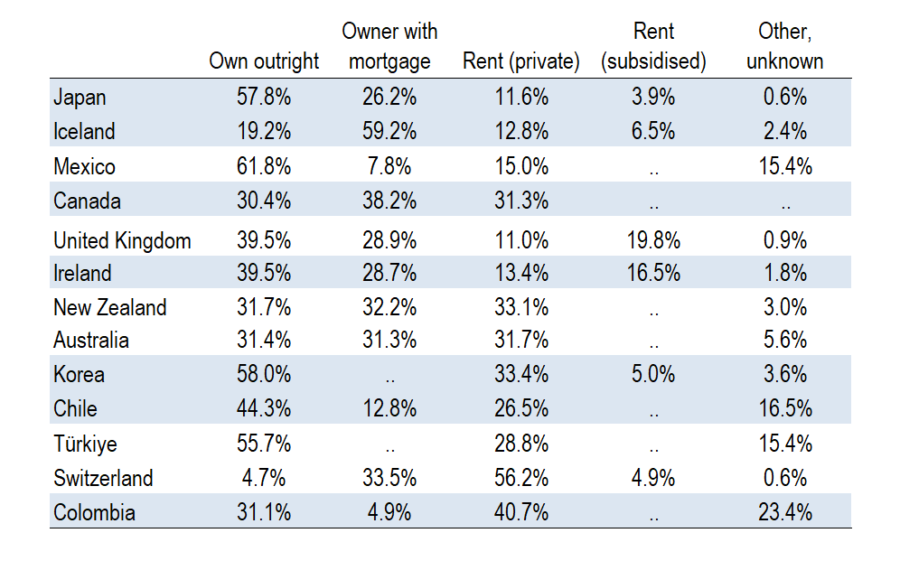
Homeownership is the most common form of housing tenure in most countries, according to the Organisation for Economic Co-operation and Development – OECD. The data refer to 2024 or the latest available year for a particular country. The overall ownership rate is calculated by combining two categories: homes owned outright and homes purchased with a mortgage.
According to the organisation’s latest report, 68% of households in Canada live in their own homes, while 31% rent.
Japan: 84.0% live in their own homes, while 15.4% rent.
Iceland: 78.4% live in their own homes, while 19.2% rent.
Mexico: 69.6% live in their own homes, while 15.0% rent.
United Kingdom: 68.4% live in their own homes, while 30.7% rent.
New Zealand: 63.9% live in their own homes, while 33.1% rent.
Australia: 62.7% live in their own homes, while 31.7% rent.
South Korea: 58.0% live in their own homes, while 38.3% rent.
Türkiye: 55.7% live in their own homes, while 28.8% rent.
Switzerland: 38.2% live in their own homes, while 61.2% rent.
Norway: 80% live in their own homes.
China
According to CNN, based on various reports and data, approximately 90% of people in China own a home, while rented housing accounts for around 10%.
The high ownership rate is mainly linked to the privatisation of housing stock previously owned by the state and former work organisations known as Danwei. People in China also acquire their own homes at a relatively early age compared with other countries. According to 2018 data, the average age of homebuyers was approximately 29.5 years.
The Post-Soviet Region
A high percentage of the population in post-Soviet countries owns residential property. This has been influenced mainly by privatisation, inherited property, the large number of private houses in rural areas and a less protected rental market.
In Russia, according to the latest 2023 data published by Trading Economics based on Rosstat, the homeownership rate is 92.6%.
As for Armenia, according to the 2022 census, 89.4% of households live in housing owned by their members.
In Azerbaijan, according to the latest 2024 data, approximately 95% of families live in housing owned by the family. The share renting from a private individual is 0.5%. The remainder mainly lives in state-owned housing.
Ultimately, the statistical data reviewed show that the desire to own a home is not characteristic only of Georgian culture. In most of the countries presented in the article, more than half of the population lives under its own roof.
The American publication U.S. News & World Report, in the article “Should You Buy or Rent a Home in 2026? A Decision Guide”, writes that there is no single correct choice between buying and renting. The decision depends on a person’s financial situation, life plans and the local market.
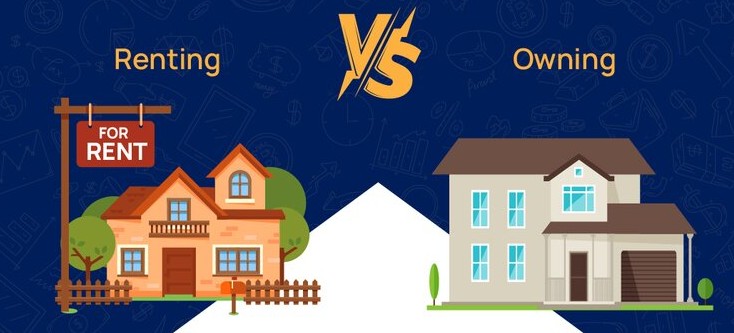
Because of high mortgage rates and the upfront costs associated with buying an apartment, renting is often cheaper. It is a better choice for people who do not plan to stay in one place for a long time, do not want responsibility for repairs and home maintenance, or prefer to invest their savings elsewhere.
Buying is more justified when a person plans to live in the home on a stable, long-term basis, has funds available for a down payment, wants full control over the property or wishes to accumulate capital through real estate.
The images were generated by artificial intelligence.
Author: Lika Kasradze
To invest in real estate in Georgia, Kedaro Group is ready to provide consultation:
– Email us: Kedarogroup@gmail.com
– Call us: +995 593618181
– Or visit us at: 18/22 G. Atoneli Street, 0105, Tbilisi, Georgia.