In general, residential property tax systems across Europe are fairly complex and vary significantly from country to country. However, the primary focus is usually on four types of taxes:
1. Property transfer tax (purchase tax);
2. Annual property tax;
3. Rental income tax, if the property is rented out;
4. Capital gains tax upon the sale of the property.
Taking these four components into account, the international real estate research platform Global Property Guide analyzed property tax systems across Europe and ranked the countries with the highest and lowest property taxes.
Property Transfer Tax
In many European countries, this tax is also referred to as stamp duty.
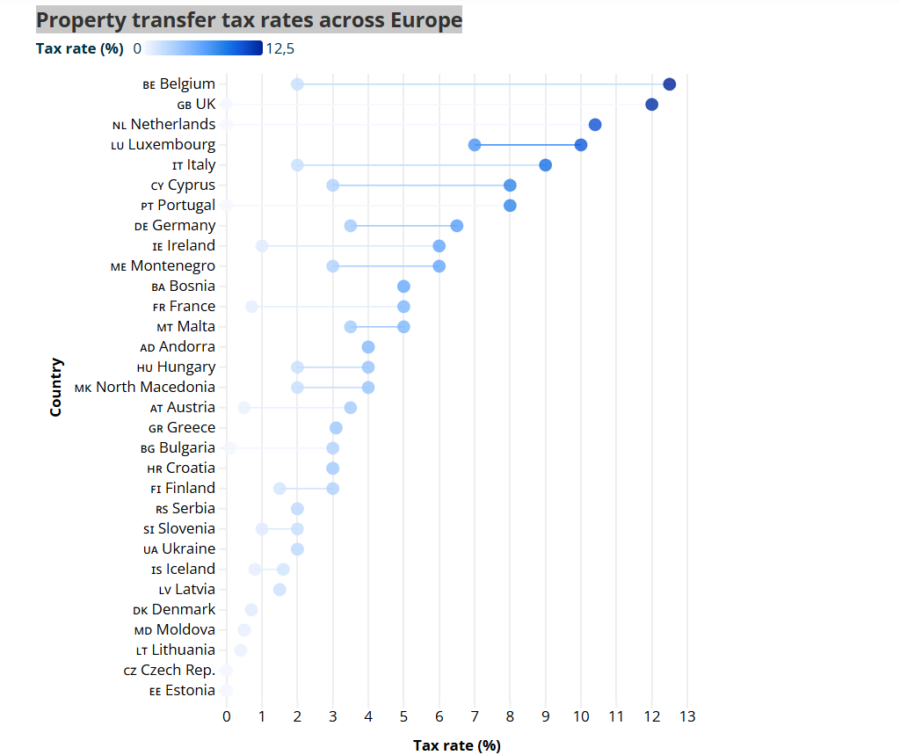
Belgium ranks first in Europe when it comes to property purchase and transfer taxes. Buyers there may have to pay up to 12.5% of the property’s value. In Belgium, the tax is determined by region, meaning the location of the property within the country significantly affects the amount payable.
Belgium is followed by the United Kingdom, with a maximum rate of 12%, the Netherlands at 10.4%, and Luxembourg at 10%.
At the bottom of the ranking are Estonia and the Czech Republic, where no property transfer tax is charged when purchasing real estate.
In Lithuania, acquisition-related charges amount to approximately 0.4%. For a home worth €500,000, that comes to roughly €2,000.
Figure: Property transfer tax across European countries. Source: Global Property Guide
Annual Property Tax
Extra caution is needed when comparing annual property taxes. This is where people most often make mistakes, as countries rely on different systems to calculate the tax. Depending on the country, property tax may be based on the market value, assessed value, or cadastral value of the property.
Cadastral value – a taxable value determined by the government and used to calculate property tax;
Assessed value – the value of a property determined by an independent appraiser or the relevant authority, which may be used for various purposes, including taxation;
Market value – the estimated price at which a property could realistically be sold on the open market at a given time. It is influenced by factors such as location, condition, renovations, supply and demand, and other market conditions.
Some countries determine property taxes based on property value bands rather than a percentage of the property’s value. For example, in the United Kingdom, properties are assigned to specific valuation bands according to their value and are taxed at a fixed rate based on the applicable band.
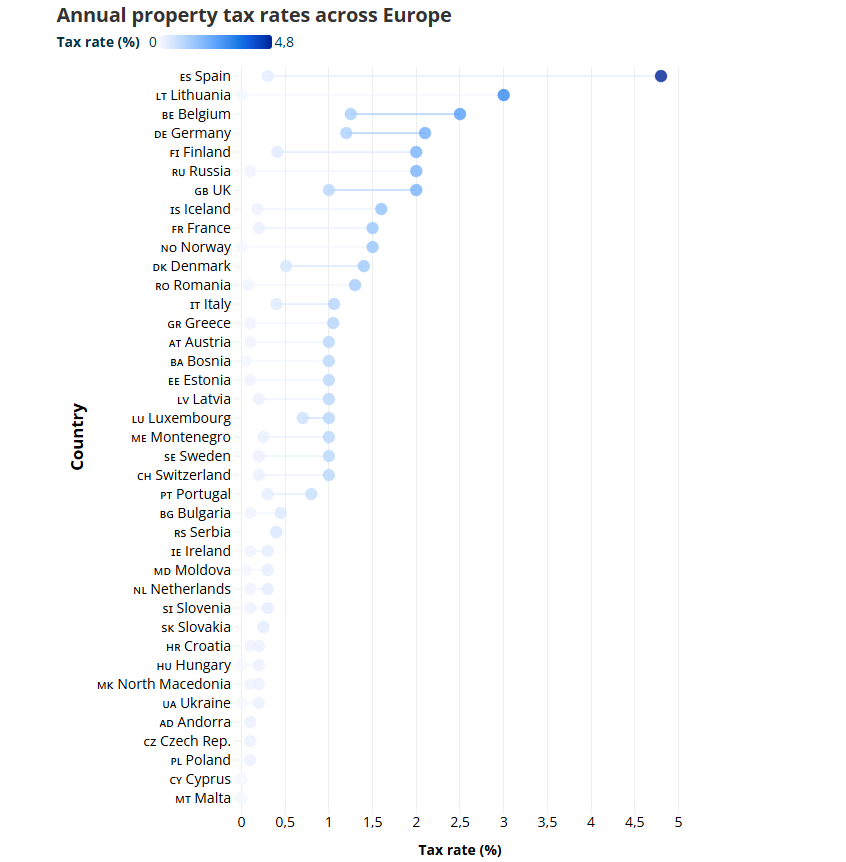
In some municipalities in Spain, the maximum annual property tax rate reaches 4.8%. However, the tax is applied to the cadastral value, not the market value (the cadastral value is always lower than the market value). Therefore, what appears to be a high tax rate does not necessarily reflect the actual tax burden.
In Cyprus and Malta, property owners pay no annual property tax, as neither country levies such a tax.
In many countries, property owners may still be required to pay annual property tax even if the home is vacant and unoccupied.
Figure: Annual Property Tax. Source: Global Property Guide
How Is Rental Income Taxed in Europe?
Across Europe, rental income tax is generally determined by the amount of income earned from renting out a property.
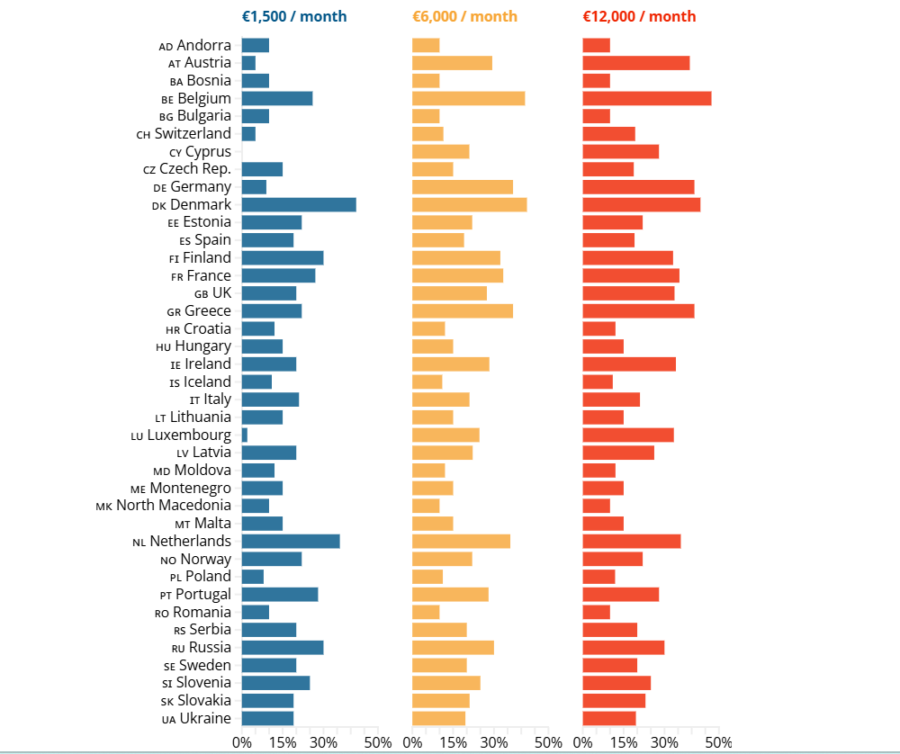
Global Property Guide calculated how much tax a non-resident property owner would pay if they earned €1,500, €6,000, or €12,000 per month in rental income.
For a monthly rental income of €1,500, Denmark has the highest tax rate at 42.11%, followed by the Netherlands (36%) and Finland (30%). In Cyprus, rental income at this level is taxed at 0%, while in Luxembourg, the rate is only 2.94%.
For a monthly rental income of €12,000, Belgium ranks first, with a tax rate of 47.27%. It is followed by Denmark (43.22%), while Germany and Greece both impose a 41% tax rate.
In some countries, the tax rate changes very little as rental income increases. For example, the rate remains 21% in Italy, 28% in Portugal, and 36% in the Netherlands, regardless of how much rental income is earned.
The steepest increases occur in countries where rental income is treated as part of an individual’s regular taxable income. Austria is a good example. There, rental income is taxed under the same progressive tax system as employment income. Income of up to €13,308 is taxed at 0%, while income exceeding €1 million is taxed at a rate of 55%. As a result, in such countries, rental income tax effectively becomes part of the standard personal income tax system.
Figure: Rental Income Tax Rates in Europe for Monthly Rental Income of €1,500, €6,000, and €12,000. Source: Global Property Guide.
Capital Gains Tax
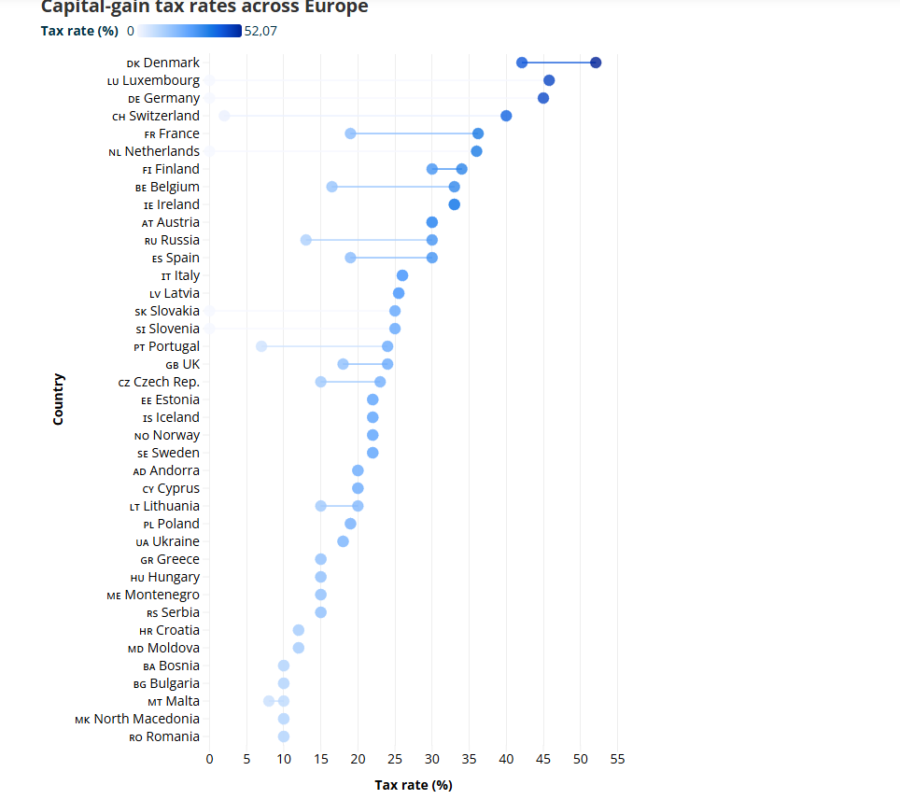
Capital gains tax varies significantly from country to country. In many cases, one of the most important factors is how long the owner has held the property.
Denmark is among the countries with the highest capital gains tax rates. There, capital gains are added to an individual’s total taxable income, and the tax rate can reach 52.07%.
For example, if you make a €250,000 profit from selling a property, you could pay up to €130,000 in taxes.
The system in Malta is entirely different. Capital gains are not taxed at all. Instead, a flat 12% tax is levied on the sale price as a transaction cost. If you sell the property within five years, the rate is reduced to 5%.
Germany follows yet another approach. If you have owned a property for more than 10 years, the entire gain from its sale is completely tax-exempt. If the property is sold within 10 years, the gain is taxed at your applicable personal income tax rate and, where applicable, is also subject to the Solidarity Surcharge.
Figure: Capital Gains Tax on Property Sales. Source: Global Property Guide.
Taking all four categories into account, Euronews reports that Belgium ranks among the countries with the highest overall tax burden on buying, owning, and generating rental income from real estate.
For property owners, Cyprus and Malta are considered among the most tax-friendly countries in Europe. In Cyprus, rental income tax starts at 0%, while in Malta, capital gains are not taxed at all. In addition, neither country imposes an annual property tax.
Now Let’s Take a Look at Georgia’s Property Tax System
Georgia is not included in the Global Property Guide study. However, the country’s property tax system can be summarized according to the same four categories:
1. Property Transfer Tax:
Georgia does not impose a property transfer tax (stamp duty) on real estate purchases. Buyers only pay a property registration fee to the National Agency of Public Registry, which depends on the processing time. The fee is GEL 150 within four business days, GEL 270 within one business day, and GEL 350 for same-day registration.
2. Annual Property Tax:
Unlike many European countries, not all property owners in Georgia are subject to annual property tax. The tax depends on both the household’s annual income and the value of the property. Individuals with an annual household income of up to GEL 40,000 are exempt from annual property tax. For those with higher incomes, the tax rate ranges from 0.05% to 1% of the property’s value.
3. Rental Income Tax:
If a residential property registered in the name of an individual is rented out, the rental income is taxed at 5%. For commercial property, the applicable tax rate is 20%.
4. Capital Gains Tax:
If an individual sells a residential property more than two years after its purchase, they are exempt from paying personal income tax on the sale. If the property is sold within two years, the seller pays 5% tax on the capital gain (profit).
It is worth noting that foreign nationals are allowed to purchase residential and commercial real estate in Georgia with full ownership rights. The only restriction applies to agricultural land.
Georgia’s tax system is also relatively simple. This simplicity is one of the reasons why Georgia’s real estate market is considered among the most attractive in the world. In practice, property registration can be completed in as little as one business day.
Ultimately, foreign investors should keep in mind that the purchase price of a property is only the initial cost. A smart investment is largely determined by how much of your return you are able to keep after taxes under a country’s tax system. As a result, capital naturally tends to flow toward countries that offer stability, lower taxes, and a simple, transparent tax system.
Main image is generated with AI.
Author: Lika Kasradze
If you are considering investing in real estate in Georgia, Kedaro Group is ready to provide you with professional guidance.
Contact us:
Email: kedarogroup@gmail.com
Phone: +995 593 618 181
Address: 18/22 G. Atoneli Street, 0105 Tbilisi, Georgia