Housing is a basic human need. Among the essential requirements for human survival, shelter, a home, ranks among the top priorities, alongside air, water, food, and safety. Yet in today’s world, owning a home has also become one of the most expensive necessities.
Residential real estate prices continue to rise year after year. In Tbilisi, for example, housing values have increased by 62% compared to 2020. Across Europe, annual growth in residential real estate prices exceeds 5%.
At the same time, incomes are not growing at the same pace.
This raises key questions: why are housing prices increasing when people are not getting richer? And why do real estate prices not decline during global crises?
There is no simple answer, as price dynamics depend on multiple factors. Before examining these factors, it is important to look at how affordable housing is across different parts of the world.
The house-price-to-income ratio is an internationally recognized indicator used to measure housing affordability. It is calculated by dividing the median price of a home by the median annual household income. In simple terms, it answers the question: how many years of income are required to purchase a home?
For example, if a household earns $10,000 annually and the average home costs $100,000, the ratio is 10. The higher the index, the less affordable housing becomes for local residents. A ratio of 3–5 is generally considered affordable; 5–10 indicates that housing is expensive; and values above 10 suggest that housing is largely unaffordable for the local population and may signal market stress.
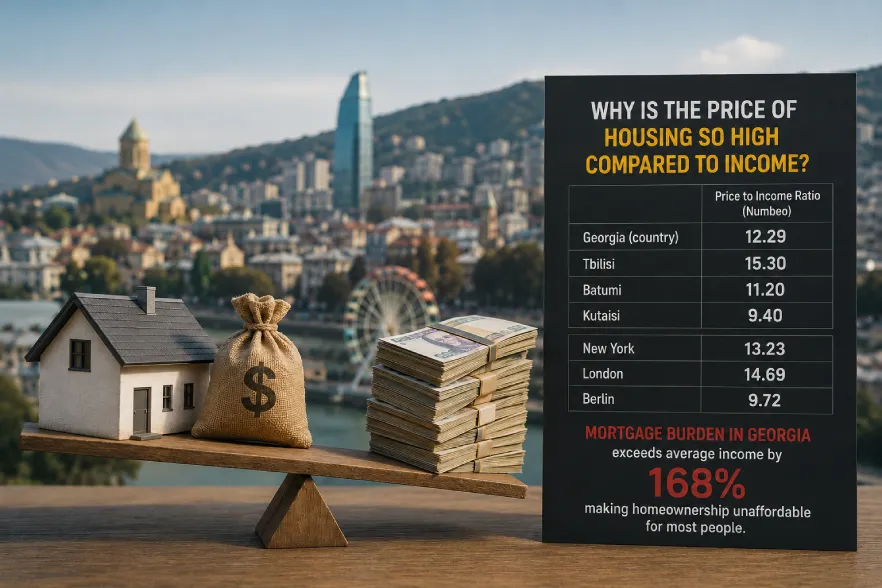
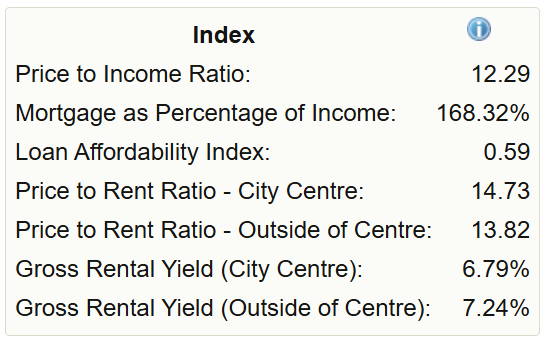
According to Numbeo, the house-price-to-income ratio in Georgia stands at 12.29. In Tbilisi, it reaches approximately 15.3, compared to 11.2 in Batumi and 9.4 in Kutaisi. For comparison, the ratio is 13.23 in New York, 14.69 in London, and 9.72 in Berlin.
The same source indicates that mortgage payments in Georgia account for about 168% of average income, meaning that purchasing a home through financing is effectively out of reach for a large share of the population without additional financial resources.
Globally, the highest ratios are recorded in Lagos (Nigeria) at 102.5, Colombo (Sri Lanka) at 49.5, and Hanoi (Vietnam) at 39.6. At the other end of the spectrum, some U.S. cities show much lower ratios; for example, in St. Louis, Missouri, the ratio is just 2.0, indicating significantly greater affordability.
Looking at neighboring countries, the ratio stands at 17.9 in Yerevan, 16.5 in Baku, 10.1 in Istanbul, and 21.2 in Moscow.
Across Europe, the highest ratios are observed in Lisbon (19.2), Tirana (18.8), Prague (18.6), Milan (18.2), and Split (18.1), indicating that housing prices in these cities are nearly 18–19 times higher than average incomes. By contrast, the lowest ratios are found in Glasgow (5.0), Liverpool (4.8), Tarragona (4.7), Cork (4.6), and Aberdeen (4.0), suggesting relatively higher affordability, particularly in cities across the United Kingdom and Ireland.
Turning to the underlying drivers of price growth, the first and most important factor is strong demand. In Southern Europe, particularly in coastal countries such as Spain, Portugal, and Croatia, foreign buyer interest plays a significant role in pushing prices higher.
In major cities and resort destinations, foreign buyers often purchase apartments for short-term rental to tourists, further increasing demand.
At the same time, according to the European Commission, housing prices are under constant pressure due to limited new construction, rising building costs, labor shortages, high land prices, and lengthy administrative procedures. Increasing material costs are also frequently cited as a contributing factor.
In Central and Eastern Europe, price growth is largely driven by strong economic expansion, infrastructure investment, and capital inflows.
Another important factor is the role of global capital. Real estate markets are no longer driven solely by local buyers. High-end development projects increasingly attract international investors, and the prices set for these properties often have little relation to local income levels.
In addition, real estate is widely viewed as a relatively safe investment. In times of economic uncertainty, inflation, and financial volatility, many people turn to property as a store of value. As a result, demand may not decline during crises, and in some cases may even increase, helping explain why housing prices do not fall significantly during global downturns.
Geopolitical factors also play a role. For example, following the outbreak of the Russia–Ukraine war in 2022, increased migration to Georgia led to a sharp rise in demand, driving up both property prices and rental rates.
More broadly, during periods of conflict and instability, global capital tends to move toward relatively safer regions, placing additional upward pressure on local real estate markets.
Ultimately, the real estate market is no longer driven primarily by local buyers. Prices are increasingly shaped by global demand, investment flows, and capital mobility rather than household incomes. This helps explain why housing prices continue to rise even when incomes stagnate, and why they do not decline significantly during global crises. As a result, residential real estate is steadily evolving into an investment asset, which is likely to further intensify affordability challenges in the future.
Author: Lika Kadradze
If you are considering investing in real estate in Georgia, Kedaro Group is ready to provide you with professional guidance.
Contact us:
– Email: kedarogroup@gmail.com
– Phone: +995 593 618 181
– Address: 18/22 G. Atoneli Street, 0105 Tbilisi, Georgia