
Overall, housing prices increased by 5.1% in the euro area and by 5.5% across the European Union over the past year.
In the fourth quarter of 2025, house prices, as measured by the House Price Index, increased by 5.1% in the euro area and by 5.5% in the EU compared with the same quarter of the previous year.
These figures come from Eurostat, the statistical office of the European Union.
In the third quarter of 2025, house prices increased by 5.1% and 5.4% in the euro area and EU, respectively. Compared with the third quarter of 2025, house prices increased by 0.6% in the euro area and by 0.8% in the EU in the fourth quarter of 2025.
Among the Member States with available data, one country recorded an annual decline in house prices in the fourth quarter of 2025, while twenty-five reported annual growth. The decrease was observed in Finland (-3.1%), whereas the strongest increases were seen in Hungary (+21.2%), Portugal (+18.9%), and Croatia (+16.1%).
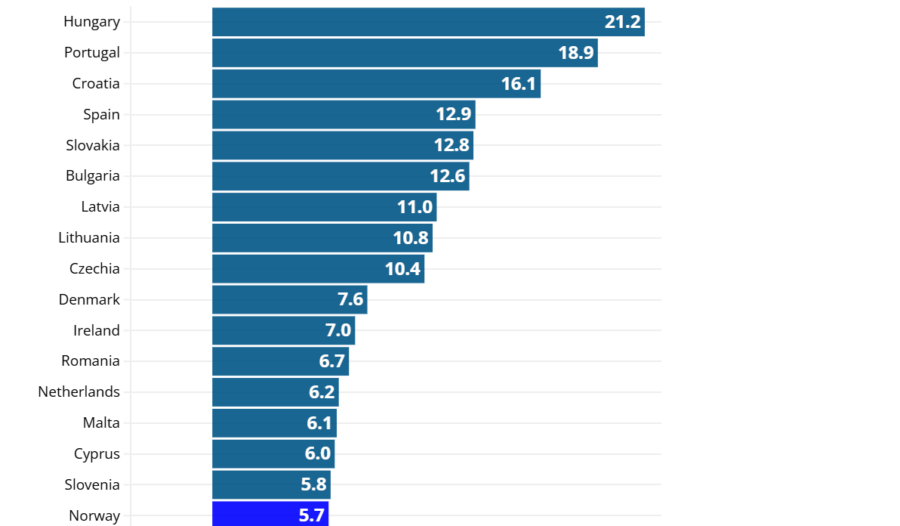
Quarterly, prices fell in three Member States, remained unchanged in one (Cyprus), and rose in twenty-two. Declines were noted in France (-0.7%), Finland (-0.5%), and Estonia (-0.3%), while the most significant gains were recorded in Slovenia (+5.1%), Hungary (+4.2%), and Portugal (+4.0%).
Experts say this surge has been driven in part by government-backed homeownership subsidy programs introduced in recent years, which have boosted demand. This has been further supported by strong investor activity, contributing to the rapid growth in prices.
In the euro area, Portugal and Croatia also recorded sharp price increases of 18.9% and 16.1%, respectively, followed by Spain with a 12.9% rise.
Experts note that strong international demand has been a key driver in all three countries. Demand from second-home buyers, foreign investors, retirees, and digital nomads has remained resilient, even as domestic borrowing costs have increased—particularly in coastal and major urban markets.
In Portugal, experts say price growth has been driven primarily by a severe shortage of housing supply, especially in Lisbon, Porto, and surrounding areas, along with targeted government support measures. They highlight that demand has been further boosted by the introduction of a public guarantee scheme for young first-time buyers, which allows up to 100% mortgage financing, with the state guaranteeing up to 15% of the property value.
Slovakia (12.8%), Bulgaria (12.6%), Latvia (11%), Lithuania (10.8%), and Czechia (10.4%) also posted strong house price growth, all exceeding 10%. Experts note that Central and Eastern Europe, along with the Iberian region, have been among the strongest-performing markets over the past 12–18 months, largely in line with stronger economic growth. These markets are also benefiting from increased infrastructure investment and capital inflows—driven both by lifestyle-related relocation and long-term economic prospects.
Among the EU’s four largest economies, Spain stood out with a 12.9% increase in house prices, while Italy recorded a 4.1% rise.
Germany saw a more moderate increase of 3%, whereas France ranked among the lowest-performing markets in Europe, with prices rising by just 1%.
Experts explain that France is still recovering from a sharp market correction in 2023 and 2024, when rising mortgage rates and inflation significantly weakened demand.
Overall, European experts say the residential real estate market in Europe has entered a phase of steady but uneven growth.
According to the European Commission, persistent pressure on prices is driven by a limited supply of new housing, rising construction costs, labor shortages, expensive land, and lengthy administrative procedures.
This means that even if financial conditions improve, property prices are unlikely to decline automatically.
It is also important to note that the 2025 data does not yet fully reflect the impact of the Iran conflict on the real estate market. However, such crises typically tend to redirect capital flows toward more stable markets.
Source: Eurostat
Author: Lika Kasradze
If you are considering investing in real estate in Georgia, Kedaro Group is ready to provide you with professional guidance.
Contact us:
– Email: kedarogroup@gmail.com
– Phone: +995 593 618 181
– Address: 18/22 G. Atoneli Street, 0105 Tbilisi, Georgia