How do some people make money when everyone else is losing? Most investors try to escape during times of crisis, yet some act precisely when uncertainty peaks.
One such figure was Sam Zell — the architect of one of the most successful strategies in real estate history. This article explores how he leveraged financial crises to his advantage and built a fortune exceeding $5 billion.
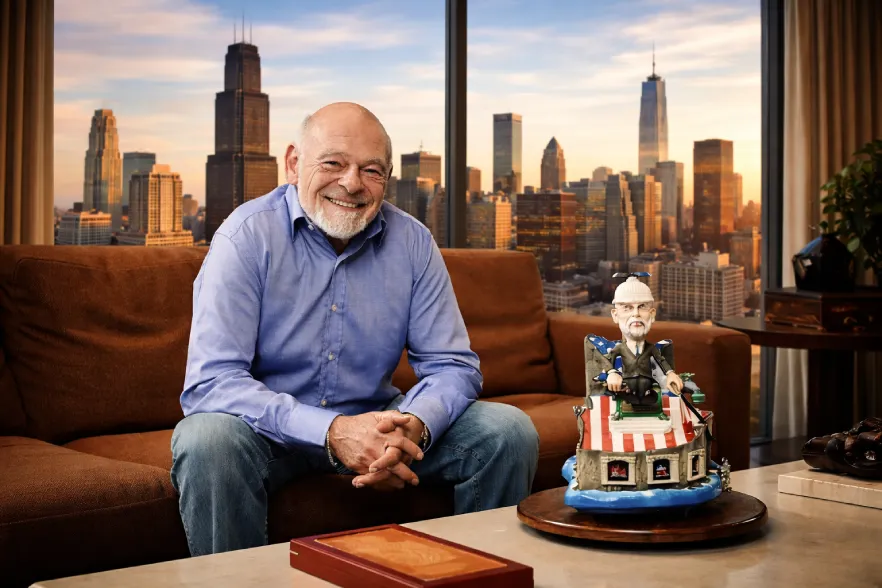
Sam Zell (1941–2023), nicknamed the “Grave Dancer,” was an American billionaire, philanthropist, and one of the most influential real estate investors of his time. According to Forbes, he was among the most successful investors in the U.S. real estate market, having built his wealth by acquiring distressed assets. His approach remains a blueprint for modern investors.
So what was his strategy? From the outset, Zell demonstrated an exceptional instinct. He consistently identified opportunities where others saw only risk. In essence, he could “read the pulse” of the market — sensing when prices were likely to rise or fall.
When property values collapsed and panic drove investors to offload troubled assets, Zell moved in to buy. He then waited patiently for the market to recover before selling at significantly higher valuations.
A striking example came just before the 2008 financial crisis. Anticipating a market slowdown, Zell sold his company, Equity Office Properties Trust, to Blackstone Group in 2007 for $39 billion. At the time, his portfolio included approximately 540 office properties across major U.S. cities such as New York, Chicago, Boston, and San Francisco. It was the largest acquisition of a real estate investment trust at the time.
Another defining moment in Zell’s career came during the global crisis of 1973–1974.
In 1973, OPEC’s Arab members imposed an oil embargo on countries supporting Israel, causing oil prices to quadruple and triggering inflation and economic recession. Stock markets collapsed, and the real estate sector soon followed. Demand for housing in the United States declined sharply, construction nearly halted, and many developers went bankrupt. Banks were left holding distressed assets.
What did Zell do? He seized the opportunity. Following a market crash in 1973, Zell spent the next three years acquiring $3 billion in real estate assets, much of it for $1 down. He made the portfolio by going to lenders and offering to take future operating losses off their hands in return for equity. Zell was able to carry the properties long enough for them to return to — and exceed –prior valuations. “As it turns out, we made a fortune,” he said.
These examples clearly illustrate the mindset of a strategic investor. Where others saw loss and uncertainty, Zell stepped outside his comfort zone — and in doing so, built enduring wealth.
It is often interesting to examine where successful individuals begin. While some inherit wealth, Zell built his from the ground up.
Born in Chicago in 1941 to Polish immigrant parents, Samuel Zell (Shmuel Zielonka) displayed entrepreneurial instincts early in life. Zell graduated with a bachelor’s degree and J.D. from the University of Michigan, and While still a student, he began purchasing properties and renting them to fellow students. He later expanded this activity with Robert Lurie, a university acquaintance who became his long-term business partner.
While practicing law, Zell and Lurie simultaneously managed residential buildings in Michigan. Within a few years, they assembled a substantial portfolio of office properties across the United States, largely by identifying opportunities overlooked by others.
Zell’s unconventional strategy earned him the nickname “Grave Dancer.” According to Zell, the term grew out of the headline of an article he wrote describing his strategy of profiting off distressed real estate following the inevitable bubbles of investment enthusiasm. Zell said the article shows how “I was dancing on the skeletons of other people’s mistakes.” Zell, however, also pointed out that the last sentence of the article reads: “He who dances closest to the graves, always has to be careful he doesn’t fall in.” Later, Zell would joke that he was not a symbol of “death,” but of “revival” — as he brought neglected and undervalued assets back to life.
Beyond real estate, Zell was also active in media and philanthropy. After selling Equity Office Properties Trust, he became the principal investor in Tribune Company, which publishes the Chicago Tribune, Los Angeles Times, and owns other media assets.
Sam Zell passed away in 2023 at the age of 81, leaving behind not only a vast business legacy but also a set of enduring insights that continue to influence investors worldwide.
“When everyone is going left, look right.”
“The definition of a good deal is when no one else wants it.”
“I’m not a market timer. I’m a value buyer.”
“Opportunities come from dislocation.”
“The only thing worse than being wrong is staying wrong.”
“In times of uncertainty, the biggest risk is doing nothing.”
“The market is not always rational, but it is always right.”
“You make your money when you buy, not when you sell.”
“I never bought anything unless I knew I could survive the downside.”
“The most intelligent investment may perform poorly if surrounded by too much supply.”
“My focus is always on the downside.”
“While real estate professionals have excellent transactional skills, they often lack the foresight to plot strategy. When it comes to delegating the negotiation of a transaction, I would always pick a real estate guy over a corporate guy. On the other hand, real estate people lack the ability to look around the corner. To them, the tree is always growing to the sky. Therefore, we have enormous and very volatile cycles that continue to this day.”
“I look at situations and act when I think the problems are temporary. I believed if you could buy assets with sufficient ability to carry them then over time you could not lose.”
“Early on I adopted a philosophy I call the Eleventh Commandment, “Thou shalt not take thyself too seriously,” and it became a governing principle in my life. Big investment deals can get heady at times, and it can be easy to start thinking your brand is bigger than your performance.”
“Faith in the future is as much motivated by confidence as it is a reflection of fear in acknowledging a mistake.”
“Technology is the ultimate definition of human capital.”
“Rather than focus on numerical indexes in investment decisions, the investor should focus on unique characteristics that protect the investment from competition. Thus bar to access is a critical element in the evaluation.”
“The most significant factor influencing real estate’s future value is competition. One could argue that the higher the occupancy and the rates, the more likely this level of performance will not continue.”
“Discipline comes from the marketplace, from fear of loss and the consequences that come from overindulgence.”
“I am very focused on understanding the downside. And I have a pretty good track record, but it’s not perfect. You can’t play at this level without some pretty big highs and lows.”
“Some might see buying and creating value from others’ mistakes as a form of exploitation, but I see it as giving neglected or devalued assets, in any industry, new life.”
“Real estate investment decisions do not lend themselves to macroeconomic issues. Real estate is a local market, by definition. lt is not possible to focus on national trends; one must focus on local issues and characteristics.”
“Reputation is your most important asset. Everything you do, everything you say, is part of the permanent record. Your name reflects your character.”
“The very important basic premise of what really is a fair deal is a deal where everybody makes money, both the sponsor and the stockholder. That is what it is all about.”
“For me, business is not a battle to be waged — it’s a puzzle to be solved.”
“Growth, demographics, and liquidity drive the real estate business.”
“People have always made money by taking advantage of inefficient markets.”
“We [my business partner and I] thought if we are good real estate guys, then we are good businessmen.”
Author: Lika Kasradze
If you are considering investing in real estate in Georgia, Kedaro Group is ready to provide you with professional guidance.
Contact us:
Email: kedarogroup@gmail.com
Phone: +995 593 618 181
Address: 18/22 G. Atoneli Street, 0105 Tbilisi, Georgia