Traditional methods of real estate investment primarily acquiring, renovating, reselling, renting out, and managing assets have worked effectively in practice for many years, and many people have built their careers around this business. At the same time, however, alternative investment mechanisms continue to evolve amid today’s technological race, and markets are changing accordingly.
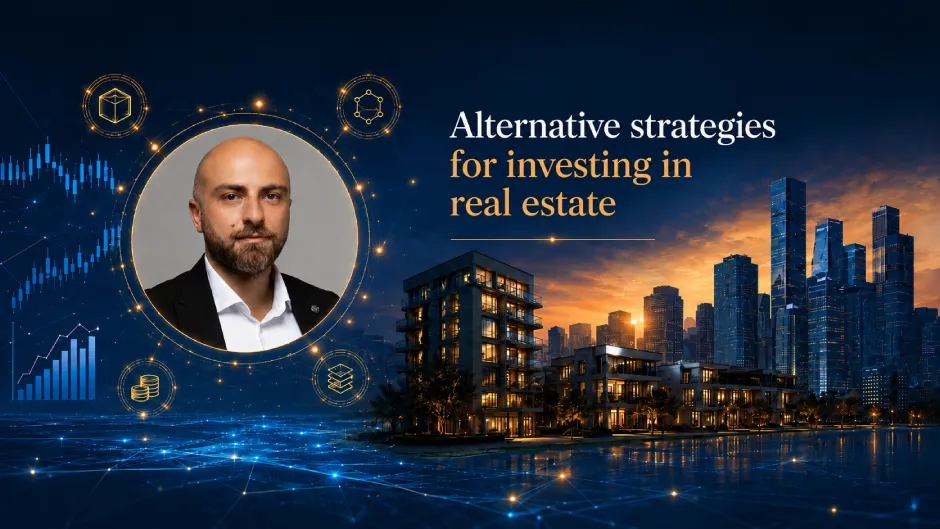
What opportunities do modern digital mechanisms for real estate investment create, what risks do they involve, what should investors verify before committing their capital, and how prepared is Georgia to develop in this direction? Kedaro News discussed these issues with Nikoloz Kandelaki. He has more than 17 years of experience in the financial sector, including seven years at the National Bank of Georgia, where he participated in developing the country’s crypto regulatory framework and headed the registration function for Virtual Asset Service Providers (VASPs).
Before turning to the respondent’s assessments, let us briefly explain what modern real estate investment mechanisms involve and how they differ from one another:
Real Estate Investment Trust (REIT) – a company that owns or finances income-generating real estate. Instead of purchasing property directly, an investor buys a share or stock in a REIT and receives income in the form of dividends.
Fractional Ownership – under this model, several investors hold shares in a single real estate asset. Instead of purchasing the entire property, an investor acquires only a specific share and receives a corresponding portion of the property’s income.
Real Estate Crowdfunding – through an online platform, many individuals pool relatively small amounts of capital to finance a real estate project jointly. In return, an investor may receive interest on the invested funds or a share of the project’s profits.
Tokenization – in this model, a share or another right associated with real estate is represented and sold in the form of a digital token. However, purchasing a token does not always mean that the investor becomes a direct co-owner of the property (see article: Tokenization: Alternative Form of Real Estate Investment).
As Nikoloz Kandelaki explains, “the models should primarily be distinguished not by the technology used, but by what the investor is actually purchasing.”
“The main forms are: a share in the real estate itself or in the company that owns it; a debt claim against a project; a unit in a real estate fund or REIT; and fractional ownership of a specific property. Tokenization and crowdfunding are primarily ways of offering and distributing these rights digitally. In practice, one of the most flexible models is often fractional ownership of real estate, either directly or through a special-purpose company, an SPV [Ed.: Special Purpose Vehicle – a company established specifically for a particular real estate asset or project, through which the property may be owned, financed, or managed],” Kandelaki says.
– What are the main differences between these models, and what advantages and risks does each of them involve?
The main difference lies in the investor’s rights and the source of return. An equity holder participates in the income generated by the property and changes in its value; a creditor receives interest but does not own the property; while a fund unit provides diversification and professional management, although the investor has less control over a specific asset. The main advantages of the digital format are a lower barrier to entry, easier transferability, and the ability to use the instrument within other financial strategies. However, a digital format does not automatically provide either security or liquidity. This requires a sound legal structure and a genuine secondary market.
– How important is the country in which the investment platform and the project itself are regulated? What exactly should an investor verify in a regulator’s register?
Every investment involves risk. Regulation is designed to reduce those risks, improve transparency, and protect investors, but it does not guarantee returns or the safety of capital. Jurisdiction is important because it determines investors’ rights, the applicable supervisory framework, and the rules for resolving disputes. Investors should check the register to confirm whether the company is genuinely licensed, exactly what activities it is authorised to conduct, and whether any restrictions or warnings have been issued against it. Given the diversity of products, there is no universal checklist; non-professional investors are also advised to seek qualified financial or legal advice.
– How should an investor verify the link between a blockchain-based token and the actual property? What does a technically sound smart contract mean?
The connection between the token and the property should be clearly reflected in the issuance and legal documentation: which property underlies it, who owns that property, and whether the investor receives an ownership interest, a debt claim, or merely a right to income. If this connection is not described directly and clearly, the instrument is not worth considering. A technically sound smart contract [Ed.: an automated program operating on a blockchain that executes transactions or other actions according to predefined rules] should comply with recognised standards, accurately reflect the rules governing issuance, transfer, and redemption, and undergo an independent security audit.
– What does the relationship between real estate and the crypto industry involve? Is it limited to real estate tokenization, or are we dealing with a much broader process?
“Crypto industry” is a very broad term. When discussing real estate, we are often dealing not with a speculative crypto asset, but with the digital representation of an equity interest, debt, or another financial right linked to property. Securities were once physical documents, then became entries in computerised registers, and now such records can be made on a blockchain. This technology should enable faster transfer of rights and more flexible and diversified management of capital.
– What is the difference between investing in a conventional crypto asset and investing in a real estate token?
“Conventional crypto asset” is an overly broad term and, on its own, does not tell us what a person actually owns. A properly structured tokenized real estate unit, by contrast, may represent an ordinary ownership interest in a specific property or in the company that owns it. The difference is that the right is recorded electronically. What matters is not the label “token,” but its legal substance: an investor must know whether they are acquiring ownership, debt, or merely a contractual claim.
– In what form can crypto assets be used in the purchase or financing of real estate, or in participation in investment projects? Under Georgian legislation, a virtual asset is not legal tender, except in certain exceptional cases.
A stablecoin [Ed.: a crypto asset whose value is generally linked to a relatively stable asset, most commonly the US dollar] may be used as a technical means of settlement, regardless of whether the investor is purchasing a tokenized or a traditional equity interest. Similar practices also occur in direct real estate transactions. However, this does not make a stablecoin legal tender: the transaction must still comply with requirements relating to property registration, source of funds, KYC/AML, taxation, and accounting. The key question is what legal right the investor receives in return and how that right is documented.
– What opportunities are currently available to Georgian citizens who want to invest in overseas real estate through modern digital platforms? How accessible are these opportunities to smaller investors, and which platforms are in greatest demand?
A significant number of international platforms are accessible to Georgian citizens, although access to a particular product depends on residency, jurisdiction, investor status, and KYC/AML requirements [Ed.: customer identification and source-of-funds verification rules designed to prevent money laundering]. The market includes both products accessible with relatively small amounts of capital and offerings available only to professional or accredited investors. The choice should be based on the investor’s risk appetite, investment horizon, expected return, and liquidity needs. The popularity of a platform alone is not a sufficient criterion.
– What is the current situation in Georgia in terms of introducing modern investment models and digital mechanisms in the real estate sector?
Georgia’s capital market remains relatively small compared with the size of the economy, due to limited market scale, low liquidity, and the significant role of bank financing. For this reason, developing alternative capital markets represents an important opportunity. Real estate is one of the most interesting asset categories: demand already exists, while digital platforms and fractional investment may broaden the investor base and create new sources of financing.
– What steps have been taken at the official level to develop digital investment in real estate in Georgia, and where do we stand compared with developed markets?
Awareness of and interest in this direction are high in Georgia, although considerable work is still required for practical implementation. Real estate owners, financial service providers, and the regulator are interested, but we have not yet achieved large-scale, measurable results. Compared with developed markets, we remain at an early stage: the next step is to transform promising initiatives into legally sound products and actual issuances.
– Can real estate become one of the main bridges between traditional finance and the crypto economy? If so, what needs to change in regulation and market infrastructure for this area to develop in Georgia in practical terms?
Real estate is one of the largest asset classes both in Georgia and globally, so this potential clearly exists. For Georgia, the opportunity is particularly interesting given the high participation of foreign investors. Development requires coordinated efforts by real estate owners, financial and technology companies, and the regulator. Market participants should establish the practical framework, while the regulator should facilitate its implementation alongside investor protection. Georgia still has an opportunity to secure a leading position, but this window of opportunity is closing rapidly.
– Could you explain more specifically what you mean when you say that the window of opportunity is closing rapidly?
The development of alternative capital markets and the RWA segment [Ed.: Real World Assets, such as real estate, whose associated rights may be represented digitally, often on a blockchain] is an attractive opportunity for any jurisdiction because these instruments provide access to capital that is significantly more flexible and global than traditional models. This is precisely why first-mover advantage [Ed.: the advantage gained by a player that enters a market ahead of others] is particularly important. The market is developing rapidly, and there is a genuine risk that key infrastructure, issuers, and investors will become concentrated in a small number of leading jurisdictions.
Around two years ago, Georgia established an important foundation through VASP legislation, its approach to tokenized securities, and the introduction of a sandbox regime [Ed.: a controlled environment established under regulatory supervision in which new financial products and technologies can be tested]. Today, however, the European Union, the United States, Switzerland, and other jurisdictions are already developing clearer and more practically applicable frameworks for regulated issuance and distribution. In Georgia, the model is theoretically possible, but practical implementation remains difficult. Therefore, preserving this window of opportunity will require faster and more coordinated action by market participants and the regulator in order to move from the experimental stage to actual issuances and scaling.
– Do you see interest in practice from foreign investors in similar modern investment instruments in Georgia, and if not, what factors are holding them back?
One indicator of potential interest is traditional real estate sales: foreign buyers account for a significant share of new real estate purchases in Georgia. It is therefore reasonable to assume that a simpler, more convenient product accessible with smaller amounts of capital would attract demand. However, there are not yet enough precedents of tokenized issuances to assess this conclusively, so actual demand will only become visible through sales results. The legal structure, returns, liquidity, and trust in the platform will be decisive.
– What would you advise Georgian investors, particularly those who want to invest relatively small amounts in real estate through modern digital mechanisms?
Before searching for a product, investors should determine what level of risk they are prepared to accept, what return they expect, how long they intend to invest their capital, and how much liquidity they require. They should then select an appropriate asset. The investment documentation should comprehensively describe the property, ownership structure, regulation, source of returns, costs, and exit terms. If the answer to any material question remains unclear or raises doubts, the investor should refrain from investing.
– One of the advantages associated with digital investment platforms is the ability to invest relatively small amounts. Does a smaller initial
investment automatically mean lower risk? How should an individual determine approximately how much they can afford to invest?
A low minimum investment reduces the financial barrier to entry and gives individuals access to assets that were previously beyond their reach — for example, a share in a hotel or shopping centre. However, this does not automatically reduce the risk of the product itself: the risks of property depreciation, poor management, and illiquidity remain the same. The amount invested should be determined by the individual’s financial circumstances and capacity to absorb losses; money required for essential expenses or short-term obligations should not be invested.
– Tokenization is often presented as a technology that reduces human-related risks. However, cases show that a project’s success still depends heavily on management, property administration, and sound risk assessment. In the case of RealToken, the company’s collapse was attributed not to the digital platform itself, but to human management failures. What conclusions can be drawn from this recent case, and how can management-related risks be reduced?
Tokenization makes processes more efficient by reducing intermediaries and automating certain operations. However, a smart contract cannot manage a building, carry out repairs, or plan tax payments. Every investment involves counterparty and management risk; tokenization may reduce these risks, but it cannot eliminate them. Investors should verify the manager’s experience, the realism of projected expenses, the existence of a reserve fund, reporting arrangements, and the mechanism for replacing the manager. The key conclusion is that technology improves the process, but it cannot compensate for weak management.
Author: Lika Kasradze
If you are interested in investing in real estate in Georgia, Kedaro Group is ready to provide consultation:
Email: Kedarogroup@gmail.com
Phone: +995 593 618 181
Address: 18/22 G. Atoneli Street, 0105, Tbilisi, Georgia